The Jerusalem Affirmation of the Nicene Faith
Published on: 18.6.2026By Dr. Jürgen Bühler, ICEJ President
Last week, the ICEJ’s Jerusalem Summit included a track that looked back at Church History and especially the Council of Nicaea of 325 AD. This church council issued the Nicene Creed to unify the expanding Christian world around the divinity of Jesus, but also steered the Church away from its Jewish roots. Here are excerpts from the presentation on Nicaea by ICEJ President Dr. Jürgen Bühler at the Jerusalem Summit.
The Council of Nicaea was convened 1700 years ago largely to resolve the dispute within the early Church over the divinity of Jesus. They responded by formulating the Nicene Creed, which adopted the concept of the Trinity as a counter to the teachings of Arius.
The emperor Constantine also summoned the Council to unify the holidays, and especially to settle on a date for all Christians to celebrate Easter. I do believe that, within the motivations of Constantine, there was a good dose of antisemitism. This spirit may not have been so present among all the Church fathers gathered there. We actually do not know, because there are no minutes from the Council of Nicaea, and they met for three long months.
But when Constantine later declared to the churches a new date for Easter, he stated the following in his synodal letter: “When the question relative to the sacred festival of Easter arose, it was universally thought that it would be convenient that all should keep the feast on one day. For what could be more beautiful and more desirable than to see this festival, through which we receive the hope of immortality, celebrated by all with one accord, and in the same manner? It was declared to be particularly unworthy for this, the holiest of all festivals, to follow the customs and the calculation of the Jews, who had soiled their hands with the most fearful of crimes, and whose minds are blinded.”
This was the second ecumenical council in Church history. The first council was right here in Jerusalem, recorded in Acts chapter 15. In that council, the gates were opened wide for Gentiles to join the Church. The big question was: What should we do with all of these believers in Yeshua who are not Jewish? Should they get circumcised or eat kosher? And the council agreed all they need to do is believe in Yeshua, and to be culturally respectful to Jews, along with observing some Noahide regulations outlined by the council. But they widely opened the doors for us as Gentiles.
What happened at Nicaea, and at other councils soon after, was they made it almost impossible for Jews to join the Church. They could not celebrate their Jewish holidays anymore, go to synagogues, or use matzah bread to celebrate Easter. And you must not call it Passover. So, there was a complete rejection of everything Jewish, and this started at Nicaea. This was not so much by what was said at Nicaea, but by what was deliberately omitted, to separate the Church from any Jewish context.
Then there were several councils that followed which slightly altered the language of the Nicene Creed. So, there is a precedent for the Creed to undergo minor changes, with its core tenets remaining intact.
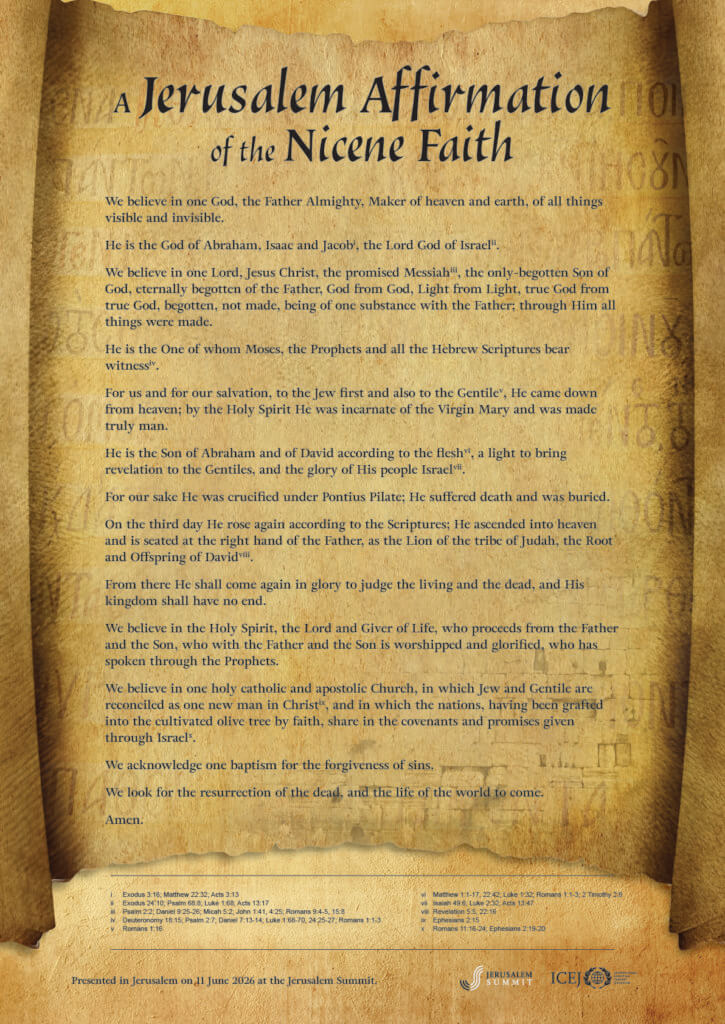
Now, the affirmed Creed that we want to release here today does not have a global magisterium, but we did run it through the magisterium of the ICEJ, through key leaders and respected theologians in our movement, and our Board of Trustees.
In this “Jerusalem Affirmation of the Nicene Faith”, we left the original Nicene Creed as it is, because it rightly affirms the divinity of Yeshua. But we felt that here in Jerusalem we need to affirm the humanity of Jesus as a Jew, which was essential to establishing his credentials as the promised Messiah. This Affirmation also aims to restore our appreciation for the uniquely central role of Israel, the Patriarchs and the Hebrew Scriptures in birthing and nourishing the Christian faith from its inception. Every new phrase added in this Affirmation is firmly grounded in New Testament texts and truths.
Ultimately, this Affirmation seeks to reaffirm the Church’s historic commitment to the Jewish people, thereby rejecting antisemitism in all its forms and encouraging a biblically based understanding of the relationship between the Church, Israel and the Jewish people.
We invite you to join us by signifying your agreement with the Jerusalem Affirmation of the Nicene Faith. This is especially needed today to restore to the wider Church a more biblical view of the rightful place Israel and the Jewish people held and still hold in God’s redemptive purposes.
Please sign and share the Jerusalem Affirmation of the Nicene Faith at: https://jerusalemsummit.icej.org/affirmation-sign