The Church in a Bubble
Published on: 30.4.2026By Dr. Jürgen Bühler, ICEJ President
Just days before Jews in Israel were to celebrate the festival of Purim, the current war with the radical Iranian regime ignited. Many Purim celebrations wound up taking place in bomb shelters, even as Israel hoped that the modern-day Haman—the militant Ayatollahs in Iran—would be brought down.
Purim is described in the Book of Esther as one of the greatest times of deliverance in the Bible. Around 470 BC, the entire Jewish population in Persia was doomed to destruction at the instigation of the vicious Haman, the senior figure in the court of emperor Ahasuerus (Xerxes). His new queen, Esther, played a counter role by exposing the plot to the king, inspired by her cousin Mordechai, who also served as a high-ranking official in his royal court.
To fully appreciate this remarkable story, I encourage you to read the entire Book of Esther. It involves a miraculous reversal in which the Jews prevailed, and those who sought their destruction were themselves destroyed.
The fourth chapter in particular recounts how this queen, immersed in the luxury of the royal palace, was transformed into a courageous woman willing to risk everything for the survival of her people.
A Queen in a Bubble
Chapter four begins with a chilling account of the desperate situation for the Jews of Persia. “There was great mourning among the Jews” (Esther 4:3), and many of them, including Mordechai, put on sackcloth and ashes as a public expression of their grief. In doing so, he violated every protocol of the royal palace. When Queen Esther heard about it, she immediately sent Mordechai a message.

Surprisingly, she seemed unaware of the plight confronting her Jewish compatriots. Instead, she sent messengers with a new set of clothes for her cousin. Mordechai, a high-ranking official in the king’s court, was known to be a relative of the queen. At first, Esther appeared embarrassed by his appearance and pressured him to change back into noble attire. Her reputation was at stake – especially since the king had not summoned her for thirty days (Esther 4:11). A cousin drawing negative attention was the last thing she needed.
Queen Esther seemed to be living in a social and political bubble within the palace, unaware of the peril to her Jewish people.
Mordechai confronted this with what we call today an “information campaign”, bringing the queen up to date on what was happening in the kingdom.
“Mordechai told him all that had happened to him, and the exact sum of money that Haman had promised to pay into the king’s treasuries for the destruction of the Jews. Mordechai also gave him a copy of the written decree issued in Susa for their destruction, that he might show it to Esther and explain it to her and command her to go to the king to beg his favour and plead with him on behalf of her people.” (Esther 4:7-8 / ESV)
Mordechai confronted her with the facts. Translated to our day, he informed her about the vast sums of money sent by the Iranian and Qatari governments to various terror networks, and about the plans of Hizbullah and Hamas to wipe Israel off the map. He also informed her about the rapid growth of antisemitism around the world, and how more and more governments are turning their backs on Israel.
He urged her to use her influence with the king – to bring this information before him and to ask for a change in policy.
Risk Assessment
Esther then went through a personal risk assessment. She began to grasp the seriousness of the situation. In principle, she likely agreed something had to be done. However, she told Mordechai the risk was too great. One could not simply walk in before the king’s throne uninvited. Anyone who broke this royal protocol faced the death penalty – even the queen herself. Moreover, she was unsure of her standing with the king, as she had not been summoned for an entire month.
Her personal assessment concluded that it was too dangerous to approach the king. This message was sent back to Mordechai.
Total Dedication
What followed is the most famous passage in the scroll of Esther… Mordechai’s final appeal:
“Do not think to yourself that in the king’s palace you will escape any more than all the other Jews. For if you keep silent at this time, relief and deliverance will rise for the Jews from another place, but you and your father’s house will perish. And who knows whether you have not come to the kingdom for such a time as this?” (Esther 4:13b–14 / ESV)
Israel and the Jewish people were not dependent on her support, Mordechai told the queen. If you remain silent, deliverance will arise from another place. In this regard, the Scriptures are clear about Israel’s future: “If the fixed order of sun, moon, and stars departs… then shall Israel cease from being a nation before Me forever.” (Jeremiah 31:35-36).
What was truly at stake was not Israel’s survival, but Esther’s own. “If you keep silent, you and your father’s house will perish” (Esther 4:14).
These words pierced Esther’s heart. She responded by calling for a three-day fast and resolved to go before the king, declaring boldly: “If I perish, I perish.”
This decision set in motion a swift process of rescue and deliverance for the Jews of that day. Yet this story also carries a powerful application for our own times.
The Church in a Bubble
Much like Queen Esther, many Christians and churches today live in a bubble. In fact, we all do. By default, we tend to focus on our own struggles and church projects, while missing the challenges unfolding around us. Esther’s main concern may have been that the king had ignored her for thirty days.

In May 1944, German pastor Dietrich Bonhoeffer wrote from his Nazi prison cell: “Our church, after fighting solely for its self-preservation during these years, as if that were an end in itself, is incapable of bringing the reconciling and redeeming word to mankind and to the world.”
Are we aware that in many European countries, statistics show that Jews face far more hate crimes than any other group – by a significant margin? In orderly places like Denmark and Norway, Jews are the target of hate crimes at a rate thirty times higher than any other group. In many cities across the UK, activists go door to door conducting so-called “polls” asking residents whether they would boycott Israel or support a Palestinian state. Responses are recorded along with addresses, leaving Jewish communities feeling deeply intimidated.

Synagogues are once again being attacked in Germany and across Europe, while Jews marking Hanukkah were recently gunned down on a beach in Australia. This is not to mention the constant angry anti-Israel protests taking place worldwide.
Jew-hatred has reached levels comparable to the early years of Nazi Germany. Tragically, as in the 1930s, many churches continue with business as usual. We must ask the Lord to burst the bubble of our lives and churches, to awaken us to the urgency of the hour.
We may be tempted to remain indifferent because most Jews are not Christians and thus do not “belong to us.” In his 1933 essay “The Church and the Jewish Question”, Bonhoeffer wrote: “The church has an unconditional obligation to the victims of any ordering of society, even if they do not belong to the Christian community.”
Mordechai launched an “information campaign” to confront the queen with the threat facing her people. For this reason, the ICEJ is holding the Jerusalem Summit this June, equipping pastors, leaders, theologians, and laypeople with the tools to preach God’s purposes for Israel from the pulpit. Please join us and share this invitation.
Risk Assessment Revisited
Initially, Esther was not willing to pay the price. The risk of approaching the king uninvited was simply too great. The question we must ask ourselves is: Are we willing to pay the price?
Recently, two churches in Europe were forced to cancel a major ICEJ conference on their premises due to external threats. They support Israel, but felt the risk was too high to host Israel-related events. Some of our national branches report that pastors still invite them to speak but privately say: “Thank you for coming to my church, because I cannot speak about Israel anymore.” These leaders have succumbed to pressure and chosen silence.
Ultimately, this question goes to the heart of Jesus’ call to discipleship. Jesus warned His disciples to “count the cost” of following him (Luke 14:25–33). He warned against double-mindedness, saying that those who put their hand to the plough and look back are not fit for the kingdom (Luke 9:62). Even family ties must not stand between us and God’s call on our lives (Luke 14:26). Following Jesus may even require a willingness to lose our lives for His sake (Mark 8:35).
This was precisely Esther’s testimony: “If I perish, I perish.” This was not fatalism, but the ultimate expression of surrender and obedience to God’s calling.
What Is at Stake?
Mordechai’s words to Esther were clear. Israel’s survival was not at stake, but her own. Germany provides a sobering example. Before World War II, Germany was known for its deep Christian heritage – the land of the Reformation and Pietism. Figures such as Luther, Zinzendorf, Bengel and others profoundly influenced the world. Yet when Hitler rose to power, the majority of churches remained silent, and many even aligned themselves with the Nazi movement. Today, most churches in Germany are empty and lack spiritual vitality.
The warning “you and your house will perish” may be more real than we realise.
How are the churches in our own countries doing? Let us pray for them.
One final thought on Mordechai’s appeal to Esther: “…and who knows whether you have not come to the kingdom for such a time as this?” (Esther 4:14)
This phrase recently struck me in a new way. Mordechai did not say, “Thus says the Lord,” but simply, “Who knows…” He was not completely certain of the outcome, yet he urged Esther to act. And Esther went, even though she did not know how it would turn out.
This reminds us of the three men in Babylon who, when threatened with the fiery furnace, declared to King Nebuchadnezzar:
“Our God whom we serve is able to deliver us from the burning fiery furnace, and He will deliver us out of your hand, O king. But if not, be it known to you, O king, that we will not serve your gods or worship the golden image that you have set up.” (Daniel 3:17–18)
Our God can and will deliver – but even if He does not, we will not bow down.
We are entering a time in which the Church is once again confronted with the Jewish question. What will we do in the face of evil against them?
My prayer is that many will find the courage to take a clear stand for our Jewish friends – to stand with them because:
They are the natural family of Jesus (Matthew 1:1);
They gave us the Word of God (Romans 3:2);
Jesus said salvation is from the Jews (John 4:22);
Paul said they are beloved for the sake of the fathers (Romans 11:28);
We are debtors to them (Romans 15:27), and
Simply because we are called to bless them (Genesis 12:3).
Many more reasons could be given, but ultimately it is simply because this is the right thing to do. The declaration “If I perish, I perish” may be a statement of faith from ancient times, but it also has profound relevance for our own day.
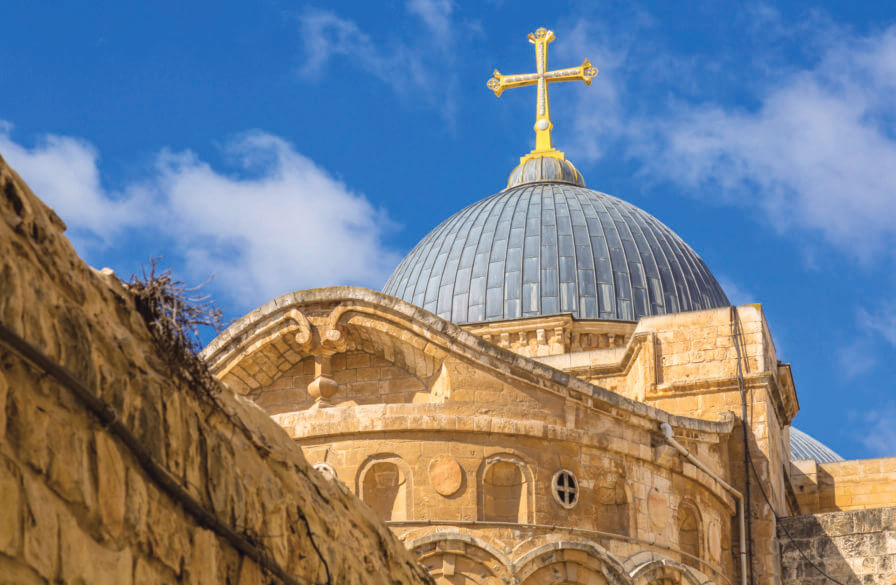
Main Photo: Church of the Holy Sepulchre (Shutterstock )
Watch our Webinar on this teaching: