Purim Lessons for the Current Standoff with Iran
Published on: 27.2.2026By David Parsons, ICEJ Senior Vice President & Spokesman
As reports filter out from the latest talks between American and Iranian envoys in Geneva on Thursday, most Israelis are anxiously expecting that any day now the United States will launch massive military strikes targeting the radical Islamist regime in Tehran. Having dispatched an enormous array of military hardware to the region, the consensus here is that it is too late for US President Donald Trump to back down now.

Israelis also are keenly aware that their nation could likely get caught up in a major war with Iran just as the Jewish people are preparing to mark the festival of Purim this coming Tuesday evening. No doubt, lots of Israelis are scouring the book of Esther for insights into why the mounting standoff with Iran is coming to a head at this very moment. The story of Purim recorded in the scroll of Esther recounts the decisive victory of the exiled Jewish people over their bitter enemies operating within the halls of power in the ancient Persian empire, and Israel sure could use a decisive victory over the evil Ayatollahs right now.
A Long and Complicated History
The events described in Esther mark a key moment in the long, complex history of relations between Israel and what today is Iran. Both sides know that history is a mixed record, marked by periods of close friendship as well as times of open hostility.
In the instance of Cyrus, this benevolent Persian monarch gave the exiled Jews a royal permit to return to Jerusalem and begin rebuilding their Temple. He even donated some of his own funds for the task.
There also were good relations between Israel and Iran during the reign of the former Shah. He even had the book of Esther read in Iranian public schools at Purim to celebrate the positive side of the historic links between the two peoples.
The current clerical regime, however, is dead set on accentuating only the negative side, as reflected in those times when Persian courtiers sought the complete annihilation of the Jewish people. They did so by conjuring up plots to deceive various kings into unknowingly signing death warrants against a people they actually admired.
The Trickery of the Jew-Haters
It is not just the scroll of Esther which reveals how relations between the Jewish and Persian peoples have been truly complicated. The book of Daniel testifies to it as well.
The learned young Hebrew exile Daniel was highly favoured by the Persian ruler Darius. But certain court advisors tricked Darius into issuing a decree that no one could pray to any other god for 30 days, knowing that Daniel faithfully prayed to the Lord God three times every day. When Darius found out the edict was intended to deliberately target Daniel, he deeply regretted it. But the “law of the Medes and Persians” held that no such royal decree could ever be altered. This meant that Daniel would have to face the lion’s den, yet he miraculously survived to the overwhelming delight of the king.
A similar plot unfolds in the book of Esther. The most senior official in the court of King Ahasuerus was a Jew-hater named Haman, who tricked the king into issuing a decree mandating the destruction of an entire community within the vast Persian realm who followed a different moral code. When Ahasuerus found out that his decree had been crafted specifically to target the Jews, including his highly trusted counsellor Mordechai, he too deeply regretted it. But he was stuck with his own edict due to the fixed nature of the law of the Medes and Persians.
A Hidden Deliverer
The book of Esther is unique in all the Bible because it is the only one which never directly mentions God. He is a hidden deliverer, working behind the scenes through a young maiden named Esther, who herself becomes a hidden means of deliverance for her people.
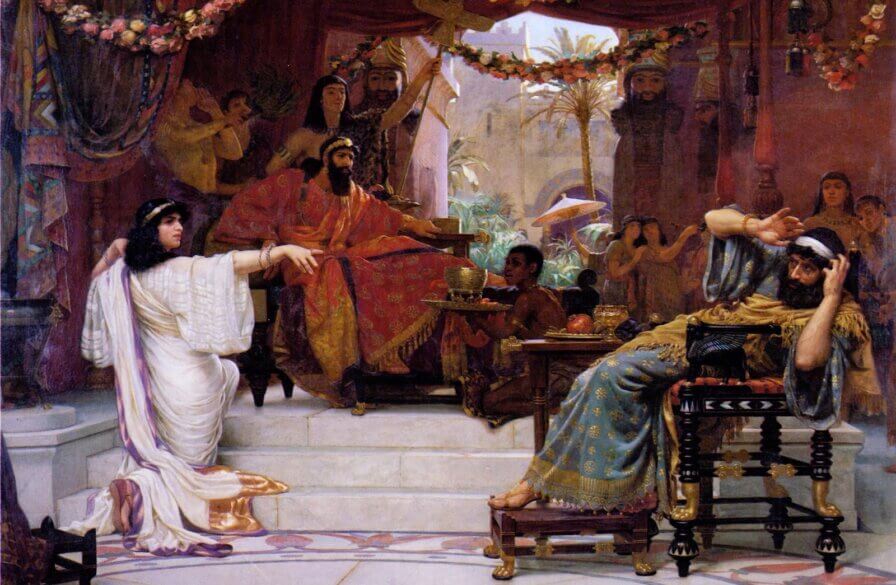
In movies and plays about Purim, the figure of Esther is usually portrayed as a fairy tale princess. She enters a beauty contest to see who will replace the deposed Persian queen Vashti as the wife of King Ahasuerus. Lo and behold, Esther wins and suddenly she is thrust into the spotlight – a radiant, lovely young woman. But she carries a secret as to her Jewish identity and has one moment before the king to plead for the rescue of her people from Haman’s evil plot, even at the risk of her own life.
So, Esther is rightly portrayed as both beautiful and courageous, which gave her great favour with the King. But the films and plays often tend to skim over the last part of the story, where her wisdom and determination shine through as well.

She tricks Haman, and deservedly so, with an invitation to a fateful banquet which he thinks is meant to honour him. She also consults with her uncle Mordechai on how to overcome the irreversible decree of destruction against the Jews by suggesting a separate decree allowing the Jews to defend themselves. And finally, she appears before the king one last time to ask for one more day to fight and slaughter the enemies of the Jewish people. That is not very princess-like, but it ensured a decisive victory that is still celebrated to this day.
A Hidden Rivalry
Also hidden within the story of Purim are clues that reveal the clash between Mordechai and Haman was just the latest episode in a long-standing rivalry between Israel and its bitter historic enemy Amalek. Haman is identified as an Agagite, meaning he was from the royal house of Agag, king of the Amalekites. Meanwhile, Mordechai is described as a descendant of Kish, from the tribe of Benjamin. These details should take us back to the account in 1 Samuel 15 of King Saul, son of Kish from the tribe of Benjamin, and his failure to kill Agag, king of the Amalekites, as the prophet Samuel had instructed.
Actually, the Amalekites had been implacable foes of Israel since the Exodus from Egypt, and the Lord even vowed that He would “have war with Amalek from generation to generation” (Exodus 17:16). Indeed, Amalek’s seething hatred towards Israel lashed out at them in the Wilderness, then in Saul’s battle with Agag, again in David’s confrontation with the Amalekite raiders at Ziklag (1 Samuel 30), and it boiled over once more in the rivalry between Haman and Mordechai in the book of Esther.
The Keys to a Decisive Victory
So, what insights can we glean from the Purim story to help Israel and America in their confrontation with Iran today?
First of all, Israel’s current struggle with Iran is complicated. The enemy is not the Iranian people, who for the most part desire friendly relations with the Jewish state and people, and many even admire Israel. The battle is against a despotic clerical regime driven by the spirit of Amalek, and it needs to be confronted in a way that separates out and spares the innocent Iranian public.
Second, the Iranian regime has been plotting Israel’s destruction by nuclear annihilation for over four decades now, and no one should be deceived by it. They have lied to the world that their nuclear program is for peaceful purposes only, even while they enrich uranium to levels used solely for military purposes. They have built secret atomic plants and buried them deep inside mountains. They have developed long-range ballistic missiles to have the means of delivering a nuclear payload. And they have been caught working on designs for nuclear triggers and warheads.
Third, Israelis must trust the Lord that He is with them and ultimately will deliver them from this diabolical plot.
Fourth, the Trump administration will surely regret any agreement it may strike with Iran right now, just as the Persian kings Darius and Ahasuerus regretted the decrees they were tricked into signing by Israel’s enemies back then. The mullahs in Tehran simply cannot be trusted to keep their word, and they are desperate for a way out. Do not give it to them!
Finally, Israel and the United States need courage and wisdom and determination – like Queen Esther of old – to see this through to a decisive victory. They must not be satisfied with a quick war that only brings partial results. They must carry on with the fight for that one more extra day needed to topple the malignant mullahs in Tehran.