Jewish youths plant deep roots in the Land
Published on: 11.2.2026ICEJ sponsors classrooms for Agro-Tech School
By Laurina Driesse
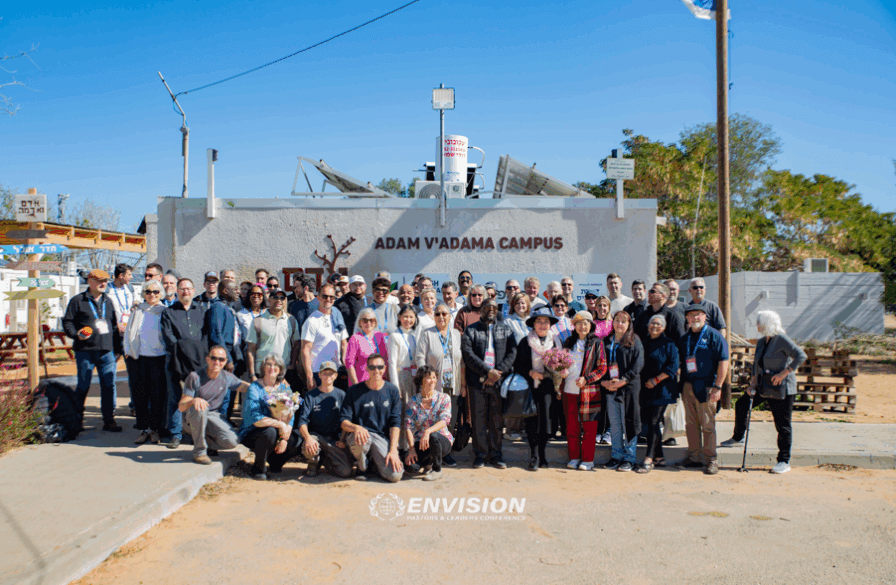
During the ICEJ’s recent Envision pastors’ conference, delegates toured Israel’s southern region and visited an innovative new Israeli Agro-Tech high school based in Sde Nitzan, where young students are planting roots deep into the Land.

Entering the school campus, delegates learned that prior to the October 7 attacks, foreign workers played a vital role in Israeli agriculture. But following the Hamas terrorist invasion, many of these workers left the country, severely cutting farm production.
In response, local educators and community leaders decided to establish a special Agro-Tech school project near the Gaza border. Its goal is to equip the next generation of young Israelis with farming skills to help rebuild the local agriculture sector, foster innovation, and strengthen their connection to this special corner of the Land of Israel. It is located in the Eshkol Valley, where the twelve Israelite spies once found the region flowing with milk and honey and much fruit (Numbers 13).
By July 2024, renovations began to transform the foreign workers’ living quarters into student dormitories and the search for teachers was underway. By September, 30 Israeli mothers sent their children to start studying at the Agro-Tech school even though there were still no classrooms. Initially, the urgent need was to build a greenhouse classroom, and the ICEJ swiftly stepped in to sponsor this. Later, classrooms were required, and the ICEJ responded with a resolute Yes! During the delegates’ visit, we were very pleased to observe that four prefabricated classrooms and a larger learning center had been delivered and would soon be used for lectures.


Ofek, the school’s principal, shared his personal journey of how he came from the north of Israel to help establish the Sde Nitzan Agro-Tech school.
“We just realised that this is what we needed to do, to bring hope, to build, to educate young people to be connected to the Land,” shared Ofek. “Last year we opened the first class with 30 students, and today 50 students are enrolled in three classes, with the school catering for grades 10-12 and students who have come from different parts of the country.
Ofek emphasised the historical importance of agricultural schools in Israel and the link between farming and visionary leadership, using the example of planting fruit in the desert. The school’s approach stresses hard work and character development to cultivate future leaders.
Three students shared their daily routines and motivations for attending the Agro-Tech school. Their day begins at 5 AM. They go to work on nearby farms to assist farmers, finishing around 11:30 AM. They return home to have lunch, then study intensively for 4 to 5 hours, finishing in the early evening. In the evenings, they take part in various activities or attend interesting cultural lectures. Despite their demanding schedule, the students value a sense of purpose and community.

“Every day I wake up with a sense of meaning which is something I searched for, and that is why I came here. Every day I wake up with a feeling that I’m rebuilding…” shared Roi. “Something that is really important to me is to work the Land of Israel.” Roi also shared that he built a new seating area for the new classes.
Natan, who is 15 years old, relayed how he has worked on many different farms, picking lemons, oranges, flowers, avocados, tomatoes and lettuce. “I personally really love the farms we work in as I really feel I am doing something meaningful,” expressed Natan. On serving people following October 7, he said: “Helping them and re-establishing this area really gives me a good feeling, like I’m doing something good. Every day when I go to sleep, I feel like I’ve done something good.”
Tamar, 16 years old, shared that her mother is a mushroom farmer, which motivated her to come to the Agro-Tech school. She saw how difficult things were after October 7, when, a month later, her mother returned to her farm to find all the mushrooms ruined and all the workers had fled.
“I understood how much hard work it takes to be a farmer and how much help is needed, so I decided that I want to do something with my teenage life… I searched for something meaningful that I could do with my life,” expressed Tamar. “I came here and saw that the kids are doing this all by themselves and that the teachers are just here for help, not doing it for us. You learn to be a leader; you learn to be someone who does stuff with your life. For me, it’s very interesting and fun to learn here.”
Omri, the school’s agronomist, informed the delegation about key research underway at the school, including integrated pest management (IPM) for onions, growing carrots in salty water and increasing oyster mushroom yields. The greenhouse also explores hydroponics and algae cultivation. The project aims to develop innovative and sustainable farming methods. The onion IPM research is groundbreaking and could revolutionise pest control.


Before the visit concluded, the Agro-Tech school leadership thanked the ICEJ for its global Christian support, while specially recognising representatives from ICEJ-Germany, ICEJ-Switzerland and ICEJ-USA.

“We are very excited about this project, and we are so glad to be able to show you this special project”, said ICEJ Vice President for Aid and Aliyah Nicole Yoder as she addressed the delegation.
The Envision delegates were also invited to work the Land by planting pumpkins and zucchinis in the field before boarding their bus.
Your support of our Israel in Crisis fund is making a huge impact on helping Israelis rebuild after the horrific events of October 7. Please continue to support the ICEJ by giving today.