Envision 2026 gives pastors fresh revelation on Israel
Published on: 12.2.2026By Laurina Driesse (with contributions by Naomi Ammon)
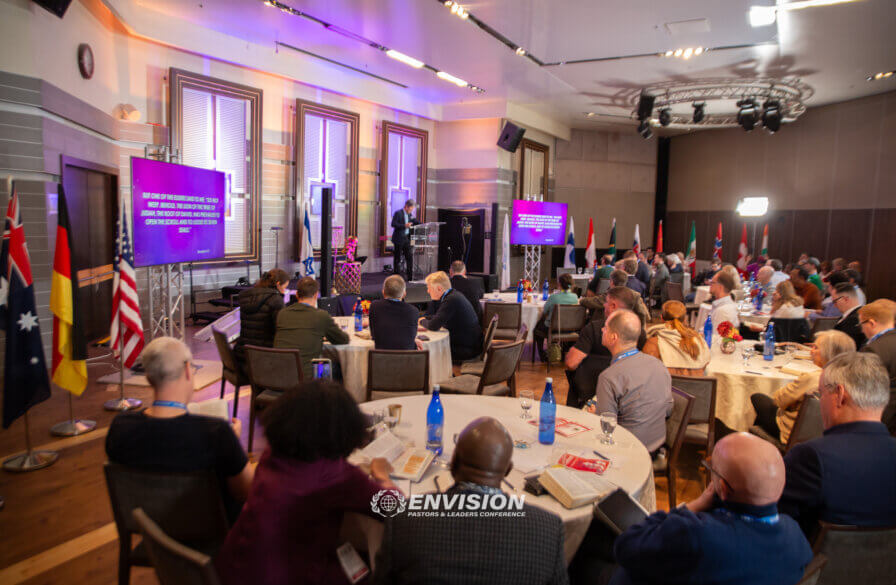
Amid rumblings of renewed war with Iran, over 70 pastors and ministry leaders from 20 nations gathered in Jerusalem in early February for the ICEJ’s Envision 2026 conference. The four-day teaching conference, held under the theme “Israel and Your Church,” offered fresh revelation and biblical understanding on Israel amid the chilling surge in global antisemitism and even denunciations of Christian Zionism from fellow evangelicals. Delegates heard from an array of Israeli and international speakers, including Bible scholars, diplomats, and security experts.
Opening Challenge

Rev. Ingolf Ellßel, Chairman of the ICEJ’s Board of Trustees, led out the conference by challenging the pastors to boldly stand with Israel, citing examples in Scripture where Gentiles gave aid and comfort to Israel in ways that pleased the Lord. Looking at the long journey of Israel, Ellßel noted it is a nation that often appears to stand alone. But he pointed to the Persian ruler Cyrus, as well as the Moabite woman Ruth who showed many kindnesses to Naomi, even as her sister-in-law Orpah turned away. This reveals two types of Christians today, he said, those who know about Israel but remain indifferent, and those who choose to truly stand with Israel.
“I don’t want any pastor to miss a blessing of God,” Ellßel concluded, reminding the delegates of the special blessing promised by God to those who stand with Abraham and his Jewish offspring.
Day Two: Teaching and Faith Diplomacy
The next day featured an excellent lineup of Bible teachers, followed by visits to the Knesset and Israeli Ministry of Foreign Affairs.
Dr. Mojmir Kallus, ICEJ Vice President for International Affairs, opened the morning sessions with a very unique take on Psalm 122 and its call to “Pray for the Peace of Jerusalem!” He used the verses of this beloved Psalm to offer a prophetic picture of how the Church should reflect God’s purposes over Jerusalem as a “house of prayer for all peoples.” He noted how an accurate understanding of Israel today closely connects many diverse Christians together, just as Jerusalem was “built as a city that is compact together.” Dr. Kallus added that the thrones set for judgement in this passage include God’s ultimate judgment of the nations over how they have treated the Jewish people.
Peter Tsukahira highlighted the current crisis of authority and authenticity in the Evangelical church, and urged that we go back to the original Jewish authors of the Bible to remedy this crisis and reconnect with the Church’s Hebraic heritage.


Prof. Gerald McDermott, an Anglican theologian, explained the biblical basis of Christian Zionism and urged a deeper understanding of Israel’s central, enduring role in God’s redemptive plan. His message focused on the historical and theological importance of the Land promise throughout the Bible, and especially in the New Testament. “It is not just the Old Testament that teaches that God gave the Land of the Canaanites as a permanent gift to the Jewish people. The Land promise is taught and implied throughout the New Testament,” McDermott assured. “Zionism is all over the New Testament.”
Irish pastor John Ahern, who has a dynamic young congregation in Dublin, then spoke on contending for the faith of our fathers. He stressed the need for pastors to be well-informed, courageous, and moved by conviction to speak out in support of Israel and the Jewish people. “If you love the God of the Bible, you love the people of the Bible… Israel still factors in God’s eternal plans”, he proclaimed. Ahern added that Israel is central to our Christian faith and history, and that the Church must stand with Israel today despite societal pressures to the contrary.
In the afternoon, Envision delegates were hosted in the Knesset, Israel’s parliament, and at the offices of the Foreign Ministry.


Josh Reinstein, Director of the Knesset Christian Allied Caucus, welcomed the pastors to the parliament of the only true democracy in the Middle East. “The Knesset is the only place where you can come, speak your mind, there’s freedom of speech, you can say what you want, and you can pray,” said Reinstein.
He also shared that the idea behind establishing the Christian Allies Caucus in 2004 was to build direct lines of communication and cooperation with Christian leaders around the world.
“We realised during the second intifada that it was Christians, not countries, which were standing with Israel,” Reinstein recounted. “We knew we had to build a new relationship between Jews and Christians, and that’s why we partnered with the ICEJ. The Christian Embassy always has a place at the table.”
“Today, the KCAC is connected to sister pro-Israel caucuses in the parliaments of 64 countries around the world”, he continued. “What we do is faith-based diplomacy, when people take their biblical support for Israel and turn it into real political action.”
Knesset member Moshe Tur Paz, co-chairman of the KCAC, told the Envision delegates that these days faith-based diplomacy is sometimes the only diplomacy that works around the world.
“Community and faith-based connections have always been something very essential for me,” he said. “Some people connect through buildings, some people connect through time, but really, faith-based people connect through their beliefs.”

David Parsons, ICEJ Senior Vice President & Spokesman, explained that many Westerners think our modern democratic systems and values came from Greco-Roman culture, when actually they derive from Israel and the Bible. Parsons noted that Isaiah 33:22 says: “For the Lord is our Judge, the Lord is our Lawgiver, the Lord is our King.”
“Here, we have the judicial branch, the legislative branch, and the executive branch all represented in one person, as only God can be trusted with all three roles of governance”, he explained. “We have to split them up and have checks and balances on power, which is the basis of our constitutional democracies. This is part of our Judeo-Christian heritage and Israel deserves the credit for giving it to us, not Athens or Rome.”
Afterwards, our entourage was hosted at Israel’s Foreign Ministry and heard from four senior diplomats – including three ambassadors. They gave overviews of Israel’s current challenges worldwide, including the rising wave of antisemitism, the Trump plan for rebuilding Gaza, and the unyielding threat posed by Iran.
That evening, Parsons delivered a message on “The Controversy of Zion”, speaking from Isaiah 34:8 about the biblical credentials for Israel’s modern-day restoration and God’s impending judgment of the nations for opposing this redemptive process.
Day Three: Israel’s Present and Future

The next day began with ICEJ-Denmark national director Nick Hansen discussing the importance of integrating Israel into our pastoral teachings. He shared a fascinating study with statistical evidence of powerful nations down through history rising and falling in economic strength based on their treatment of Israel and the Jewish people.
Hansen also drew a thought-provoking analogy between the sufferings of Job and the critical responses of his friends in comparison to how Christians have always tended to look down on a suffering Israel. “When Israel suffers, what does the Church say?” he asked. “Too often, we behave like Job’s friends in Israel’s time of persecution, critiquing and advising, not comforting and serving.”
Ramin Parsa, an Iranian Christian now living in Jerusalem, shared his transformative journey from Islam to Christianity while still in his native Iran. He also called for urgent prayer for Iran’s freedom today. He insisted that the Iranian people are hungry for the Gospel. “They’ve heard that Islam is a fraud and are coming to the Lord,” he said.
IDF Lt. Col. Ihab Shlayan, the highest-ranking officer from the indigenous Christians in Israel, then shared about the challenges faced by the local Arabic-speaking Christian community, and his efforts to fully integrate them into Israeli society. Ihab said he proudly considers himself a “Zionist” because he supports the state of Israel as the historic homeland of the Jews and a welcoming place for all its minority peoples.


Next, IDF Brig. Gen. (Res.) Amir Avivi gave an excellent strategic briefing on Israel’s current security challenges, the failures and fallout from the October 7 war, and the still looming threat of Iran’s missiles and nuclear program. He assessed that a US-led attack on Iran is still likely, and urged that it aim for a decisive victory. If Israel can consolidate its victory against Iran and its proxies Hamas and Hizbullah, he expects a surge in Aliyah to Israel by Jews from around the world.
The afternoon and evening sessions saw further presentations by Prof. McDermott, and Israeli pastors Israel Pochtar from Ashdod and Daniel Yahav from Tiberias, as well as a time of prayer led by Joshua Gooding, head of the ICEJ’s Prayer Department. In addition, Envision attendees heard from local Israeli believers Daniel and Ruth Lischinsky about the heart-rending story of their son Yaron, who was the promising young Israeli diplomat gunned down with his fiancée by a terrorist in the streets of Washington, DC last year.
Day Four: Seeing is Believing!
The last day of Envision featured a field trip to Israeli communities along the Gaza border which suffered the brunt of the Hamas terror attack on October 7. There, the Envision pastors visited an innovative new Agro-Tech high school which the ICEJ has helped launch by providing funds for a large experimental greenhouse and a four-classroom learning center. The school’s faculty shared how the vision for the school was born out of the tragic events of October 7. Several students also gave impressive explanations for why they were drawn from across Israel to study at this unique high school.


Then it was on to the site of the Nova music festival, which has become a national memorial for the hundreds of victims massacred and kidnapped on October 7. The Envision delegates were deeply moved by the way Israelis are honouring those who fell there on that dark day.
The next stop was Kibbutz Be’eri, where the group toured the damaged and burnt homes left in the wake of the Hamas invasion and heard the personal story of a survivor of the attack while standing in what was once his home. At Kibbutz Be’eri, the ICEJ has embarked on three major building projects, including a dental clinic, an activity and trauma care center for the elderly, and an after-school activity center for the youth, which delegates could see is now under construction.


The afternoon ended with a memorial ceremony hosted by the Jewish National Fund and the planting of an olive tree and dozens of red and yellow tulips at the entrance to Kibbutz Be’eri in memory of those lost on October 7. Before the sun set, the Envision pastors also made a quick bus ride to see the Christian Embassy Nature Park, located right on the border with Gaza. The ICEJ is sponsoring the replanting of this area with oak trees and other native species, and it was exciting to see all the new green growth brought out by this winter’s ample rainfall.


Pastors share on the impact of Envision
“It is really life-transforming to have feet on the ground and to be hearing the things we are hearing and visiting the places we have gone to. Just listening to different people from different nations and the transformation that God has brought into their lives, and how He is connecting truth dots; and when those truth dots come together, how people become so passionate and almost unstoppable for the things of God and His Kingdom.”
Trisha from South Africa
“Everything has been so good. I am teaching a class at my church on why to stand with Israel and the messages here are answering the questions I am getting.”
Arlene from Canada
“Including all the great teachings, I was really moved by the authenticity of the ICEJ leaders and how well they are respected. You are good news to the Kingdom. I just want to say I honour you. This was my first conference, and it definitely won’t be my last. I’m going home to organise for some people to come visit next time. I just want to say thank you. Your love for Christ is very obvious and is shown through your works.”
Harold from the United Kingdom
Watch the Envision tour to Israeli communities along the Gaza border: